Controller for electroactive polymers
Electroactive polymers (EAPs) are smart materials that change shape or size when stimulated electrically. Often called “artificial muscles,” EAPs bend, stretch, or contract in response to low-power inputs, enabling lightweight and flexible actuation for robotics, medical devices, haptics, and adaptive structures. Their ability to bridge electronics and mechanics makes them important for responsive engineered systems.
What was needed
Our client, Banrob ApS, was developing the commercial potential of haptic interfaces based on electroactive polymers (EAPs). They collaborated with researchers from Aalborg University. To do this, they needed to conduct psychophysiological studies using EAPs embedded in a series of feedback devices.
However, they realised that no EAP controller existed to provide the control they needed. They also lacked an experimental setup for psychophysiological research with EAPs. A challenge for working with EAPs is that they require control voltages in the order of 1000 volts, something standard off-the-shelf equipment cannot provide.
What was needed was a versatile EAP controller that could generate EAP activation voltages of up to 1000V proportional to an analogue input voltage. This EAP controller needed to be integrated into an experimental setup for psychophysical experiments, and experiment protocols needed to be developed to implement the testing that the scientists wanted to conduct to study the potential of EAPs for haptic interfaces.
What was done
To offset the client’s unexpected costs, we first wrote an InnoBoster application that was granted by the Innovation Foundation. This helped offset the unplanned extra costs associated with developing the EAP controller.
We then developed a four-channel 1000V high-voltage amplifier, with each channel individually controlled by an analogue voltage. These amplifiers could be stacked to control multiple groups of four EAPs simultaneously.
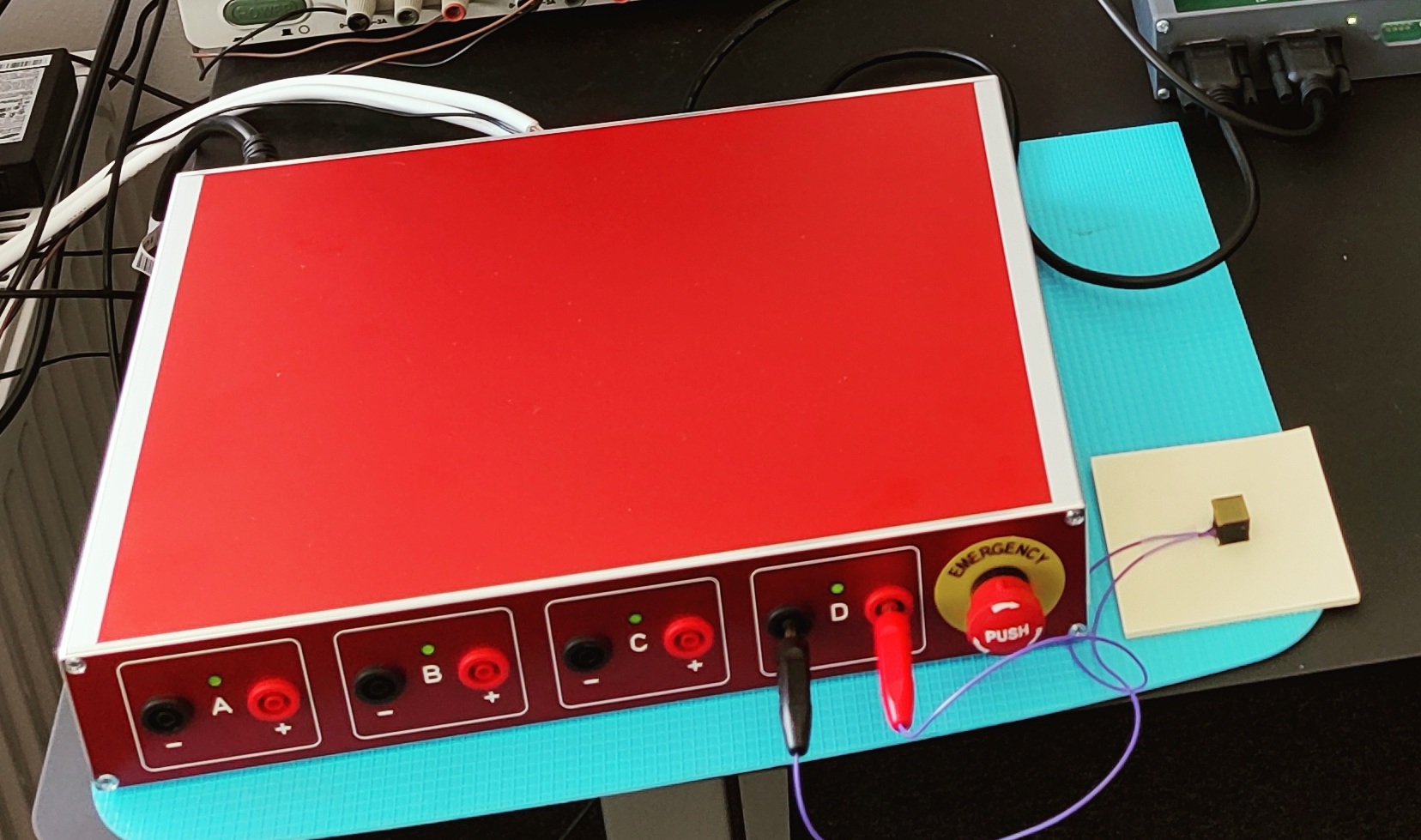
The developed EAP controller attached to a single EAP
We based the experimental setup on our LabBench software and equipment. This meant that there were no development or adaptation costs associated with the experimental setup. We then designed a protocol to test the scientists’ haptic interfaces using psychophysiological tests, including determination of psychometric functions, just-noticeable differences, and graphestesia.
To enable the experiments, we wrote and submitted an ethical application and were granted approval. The scientists successfully concluded the experiments.
What was achieved
- InnoBoster funding for the EAP controller development
- Development of a 1000V high voltage amplifier
- Ethical approval for the studies on haptic interfaces
- Experimental protocol for psychophysiological testing